
The Short Answer
A retaining wall holds soil in place. A French drain moves water away. They solve different problems, but in western Pennsylvania — where hillside lots, clay soil, and freeze-thaw cycles are the norm — those two problems usually show up together. That’s why so many Pittsburgh-area properties end up with both.
This guide breaks down how each one works, the signs that tell you which one you need, what happens when you install one without the other, and why the combination is so common in the 15108 area. T&T Landscaping builds both retaining walls and French drain systems across Coraopolis, Moon Township, Robinson Township, and the surrounding communities.
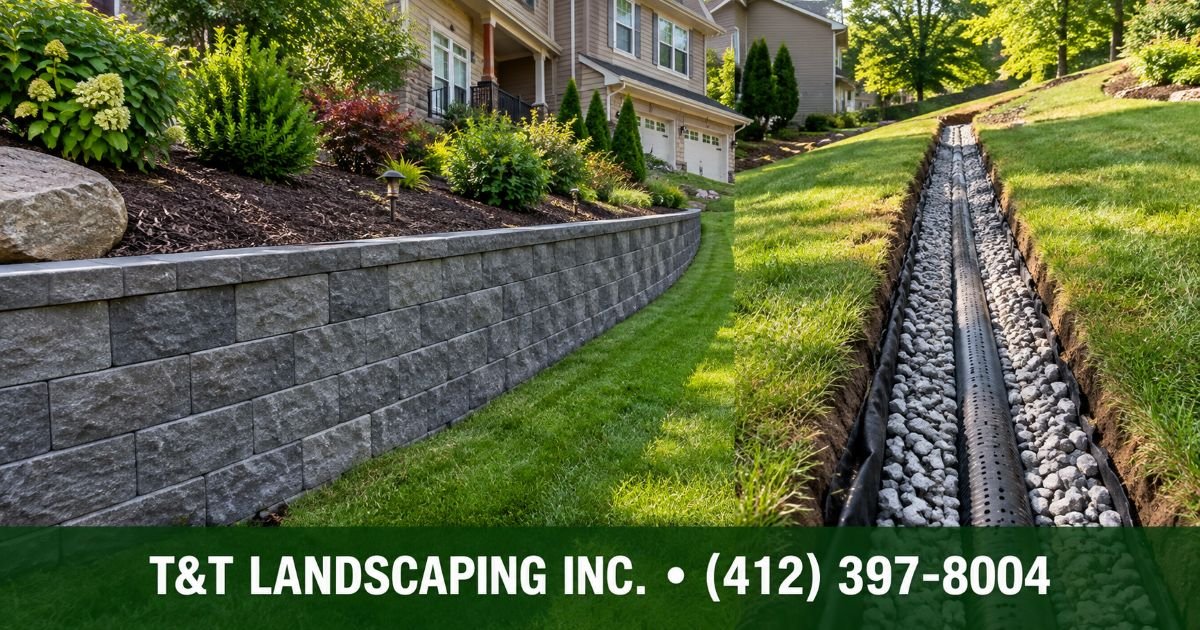
Table of Contents
What a Retaining Wall Does
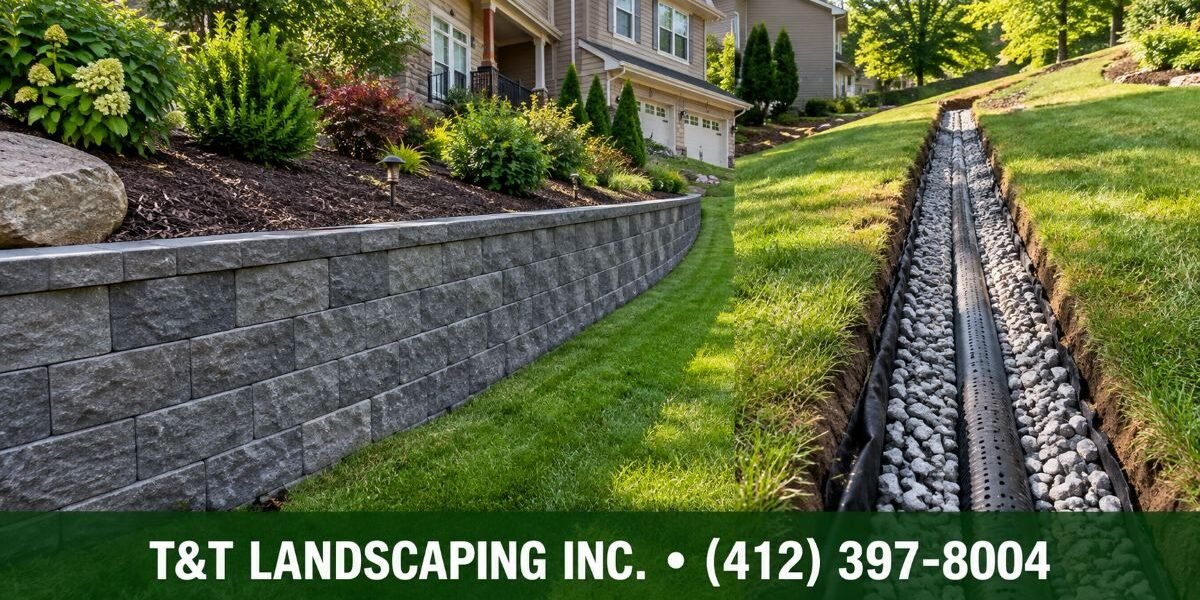
A retaining wall is a structural barrier that holds back soil on a slope. It creates a vertical or near-vertical face where the ground would otherwise erode, slide, or slump. Without a wall, gravity wins — soil migrates downhill, slowly or suddenly, taking plants, walkways, and sometimes parts of structures with it.
Retaining walls work by resisting the lateral pressure of soil behind them. The wall’s own weight (gravity walls), reinforcement that ties back into the hillside (geogrid-reinforced walls), or structural anchoring (cantilevered or anchored walls) counteracts the push of the soil. The taller the wall and the heavier the soil, the more engineering goes into the design.
Signs you need a retaining wall
If you’re seeing any of the following, a retaining wall is likely part of the solution:
- Soil washing downhill after rain. You find dirt deposits on your patio, driveway, or at the bottom of a slope after storms. The hill is migrating.
- A slope that’s visibly leaning or slumping. The surface looks like it’s sliding — bulging at the bottom, pulling away at the top. In severe cases, you’ll see tension cracks in the soil near the top of the bank.
- Losing usable yard to erosion. The flat area at the top or bottom of a slope is getting smaller every year as the slope creeps.
- An existing wall that’s failing. Old timber walls rot and lean. Stacked stone walls without proper drainage behind them push out. If an existing wall is leaning more than a couple of inches off vertical, it’s heading toward failure.
- You want to create flat usable space. A sloped yard becomes a series of level terraces with retaining walls between them — space for a patio, a garden, or just somewhere kids can play without sliding downhill.
What a French Drain Does
A French drain is a subsurface drainage system that collects water from the soil and redirects it to a safe outlet — a storm drain, a dry well, a low point on the property away from structures, or daylight at the edge of a slope. It doesn’t hold anything in place. It moves water.
The basic construction: a trench dug on a slight grade (typically 1% slope or about 1 inch of drop per 8 feet of run), lined with landscape fabric to keep soil from clogging the system, filled with clean gravel, and fitted with a perforated pipe that collects water through its holes and carries it downhill to the outlet. Water that would otherwise pool in the soil filters through the gravel and into the pipe, which moves it away.
Signs you need a French drain
If you’re dealing with any of these, a French drain (or another drainage solution) is likely the fix:
- Standing water after rain. Puddles that take hours or days to disappear. In Pittsburgh’s clay soil, this is extremely common — clay drains slowly, and water sits on top of it.
- A soggy section of yard. Ground that’s soft, spongy, or muddy even days after the last rain. The soil is saturated and has nowhere to drain.
- Water seeping into the basement. Moisture, dampness, or visible water entering the basement — especially along the base of foundation walls. Hydrostatic pressure from saturated soil pushes water through any crack or joint.
- Downspout discharge flooding the yard. Roof water dumps at the base of the house and has no path away from the foundation. The water saturates the soil next to the foundation wall.
- Erosion channels forming in the lawn. Water is flowing across the surface in concentrated paths rather than soaking in. The soil can’t absorb it fast enough.
Why Pittsburgh Properties Often Need Both
This is the part that most online guides skip, because it’s specific to terrain and soil conditions that don’t apply everywhere. In western Pennsylvania, the combination of hillside lots, clay-heavy soil, and aggressive freeze-thaw cycles creates a situation where retaining walls and French drains are not separate, optional upgrades — they’re two halves of the same solution.
The clay soil problem
Pittsburgh sits on some of the heaviest clay soil in the northeast. Clay is dense, holds moisture, and drains poorly. When it gets saturated — which happens regularly in a region that averages 38 inches of rain per year — it becomes heavy and unstable. Saturated clay behind a retaining wall is dramatically heavier than dry soil. That extra weight, combined with the hydrostatic pressure of the trapped water, pushes against the wall with far more force than the wall was designed to resist.
A retaining wall without drainage behind it is fighting a losing battle in clay soil. The water has nowhere to go, so it builds pressure until something gives — usually the wall, which leans, cracks, or collapses.
The hillside lot problem
Many properties in the Coraopolis, Moon Township, and Sewickley areas sit on slopes — some gentle, some steep. Water runs downhill. On a sloped lot, every rainstorm sends surface water and subsurface water toward whatever’s at the bottom: your foundation, your patio, your lower yard. A retaining wall can terrace the slope, but if there’s no drainage system to intercept the water moving through the soil behind and above that wall, the water just builds up behind the structure.
The freeze-thaw problem
Pittsburgh typically gets 40 to 60 freeze-thaw cycles per winter — temperatures swing above and below freezing repeatedly between November and March. Water trapped in soil behind a retaining wall freezes, expands, and pushes the wall outward. When it thaws, the wall doesn’t spring back — it stays in the expanded position. Next freeze, it moves a little more. Over a few winters, this ratcheting effect can push a wall inches off vertical.
French drains prevent this cycle by removing the water before it can freeze. A properly drained wall stays dry behind the face, which means no ice expansion, no hydrostatic pressure, and no ratcheting movement.
When You Need a Retaining Wall Only
There are situations where a retaining wall alone is sufficient:
- Short walls (under 2 feet) on well-drained soil. Low walls in sandy or loamy soil that drains freely may not need a dedicated French drain — the soil drains on its own. Even then, a gravel drainage layer behind the wall is standard practice.
- Decorative or garden walls. Small landscape walls that define planting beds or add visual structure, without significant soil loads behind them.
- Grade changes with no water issues. If the slope is stable and there’s no evidence of water accumulation behind where the wall will go, drainage may not be the primary concern. In western PA, this is rare — assume drainage matters until site conditions prove otherwise.
When You Need a French Drain Only
Sometimes the problem is purely about water, not soil movement:
- Flat yard with standing water. No slope to hold back, just poor drainage in a level area. A French drain collects the surface water and moves it to an outlet.
- Basement water intrusion on a flat lot. Water is entering the basement from ground saturation, not from a hillside pushing soil against the foundation. A perimeter French drain — interior or exterior — redirects water away from the foundation.
- Downspout and surface water management. Roof runoff and driveway runoff need to be captured and routed away from the house. A French drain with catch basins handles this without any retaining structure.
- Soggy lawn in a low spot. Water collects in a natural depression. A French drain intercepts it and moves it to a better outlet.
When You Need Both — The Most Common Scenario in Western PA
For most hillside properties in the Pittsburgh area, the answer is both. The retaining wall manages the grade change. The French drain manages the water. Together, they create a system that controls both soil movement and moisture — which is what it takes to keep a hillside property stable long-term in this climate.
The typical setup on a Pittsburgh-area hillside: a segmental block or natural stone retaining wall with a drainage aggregate (clean gravel) zone behind the wall face, a perforated drain pipe at the base of the wall sitting in the gravel, and that pipe running to daylight or a storm drain at the end of the wall. The gravel collects water that would otherwise build up behind the wall. The pipe carries it away. The wall holds the soil. Each element makes the other one work.
Without the wall, the slope erodes. Without the drain, the wall gets pushed over by water pressure. Without both, you’re addressing half the problem and watching the other half get worse.
A Simple Decision Framework
Stand in your yard after a heavy rain and ask two questions:
Is soil moving? Look for erosion, slumping, leaning banks, dirt deposits downhill. If soil is moving, you need a retaining wall (or regrading, terracing, or another earth-retention method).
Is water collecting where it shouldn’t? Look for standing water, soggy areas, basement moisture, saturated beds. If water is collecting, you need a drainage solution — a French drain, regrading, catch basins, or some combination.
If the answer to both questions is yes — and on hillside properties in western PA, it usually is — you need both, designed and installed as a single integrated system.
Cost Comparison in the Pittsburgh Area
General ranges for residential projects in the 15108 area (actual costs vary based on site conditions, access, soil, and scope):
- French drain: $25 to $60 per linear foot. A typical residential run of 40 to 60 feet costs $1,500 to $3,500. Interior basement perimeter drains with a sump pump are a different category — typically $3,000 to $8,000+.
- Retaining wall: $25 to $75 per square face foot for segmental block walls. A 40-foot-long wall that’s 3 feet tall (120 square face feet) typically runs $4,000 to $9,000 installed, depending on material and site access. Natural stone costs more. Walls over 4 feet may require engineering.
- Combined wall and drain system: When installed together, the drainage component adds relatively little to the wall cost — the excavation is already happening. Adding a French drain behind a retaining wall during construction typically adds $15 to $25 per linear foot versus retrofitting drainage to an existing wall, which requires excavating behind an already-built structure.
The takeaway: installing both at the same time is significantly cheaper than installing a wall now and retrofitting drainage later when the wall starts showing pressure damage.
T&T Landscaping — Walls and Drainage Done Right
T&T Landscaping designs and installs integrated retaining wall and drainage systems across Coraopolis, Moon Township, Robinson Township, Sewickley, and the greater 15108 area. We assess the full picture — soil, slope, water flow, and existing structures — before recommending a solution, because a wall without drainage or a drain without grade control is half a fix.
Call or text (412) 397-8004 or request a free estimate. We’ll walk the property with you and show you exactly where the water is going and where the soil is moving.