
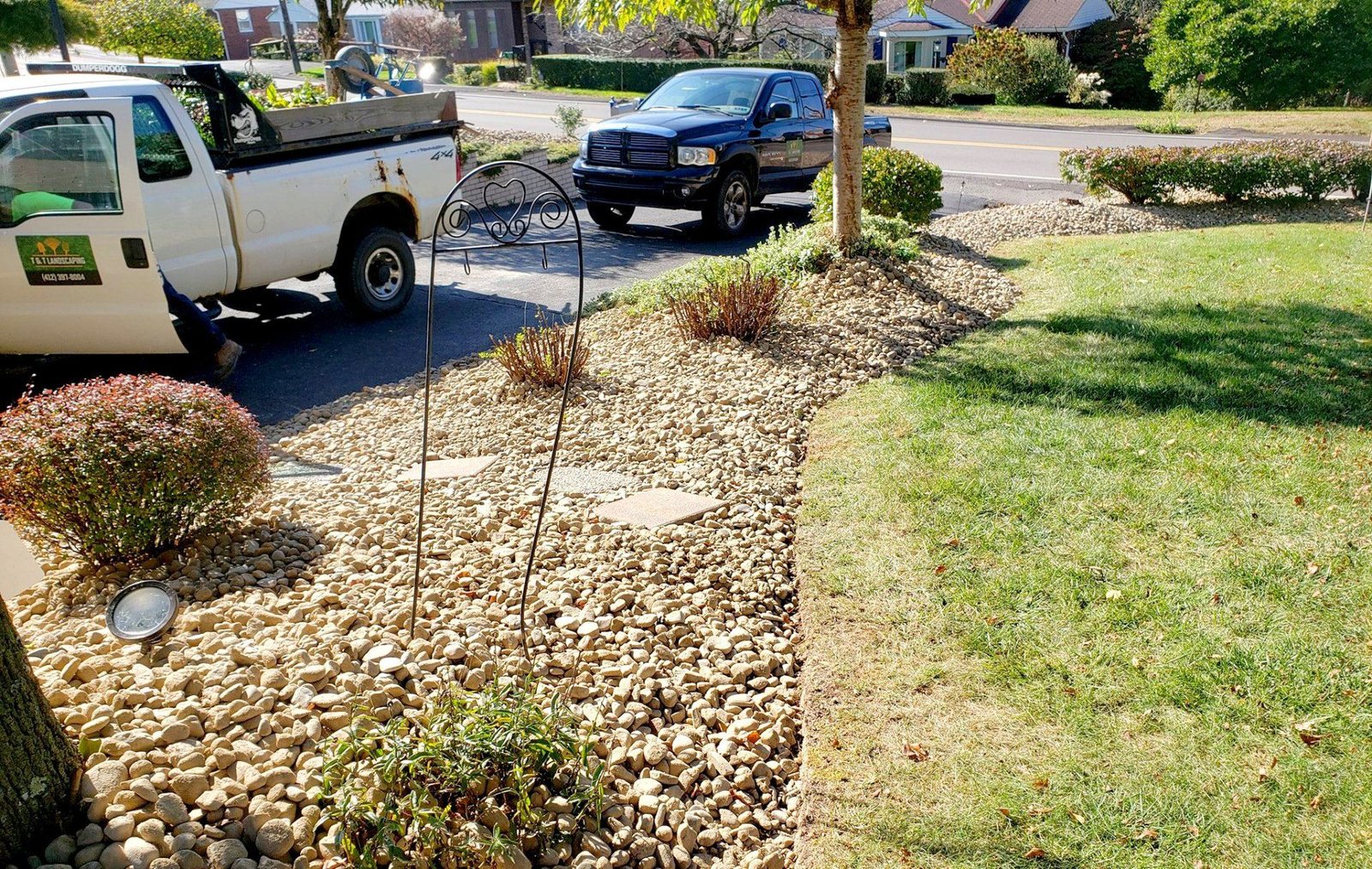
Why Driveways and Walkways Deserve Better Than Concrete
You use your driveway and front walkway more than any other part of your property. Every time you leave the house, every time you come home, every time a guest walks to your front door — that’s the surface they see and feel underfoot. In the Pittsburgh area, those surfaces take abuse: road salt tracked in from Route 60, snowplows scraping the apron, delivery trucks backing over the same spot week after week, and six months of freeze-thaw cycles trying to tear everything apart.
Most driveways and walkways around Coraopolis and Moon Township are poured concrete or asphalt. They work until they don’t. Concrete cracks. Asphalt softens in summer heat and crumbles at the edges. Both look tired after a few years and need expensive patching or full replacement within 15 to 20 years.
Paver driveways and stone walkways solve those problems. Individual units flex with ground movement instead of cracking. Damaged sections repair without tearing out the whole surface. And the finished look — whether it’s a clean herringbone driveway or a winding flagstone path — adds curb appeal that poured concrete never will.
T&T Landscaping installs paver driveways, walkways, front entries, and outdoor steps across the 15108 area and the greater Pittsburgh metro. Every project gets the same deep base preparation we put under our paver patios — because the ground doesn’t care whether a car is parked on top or a person is walking across it. It shifts the same either way.
Paver Driveways
Why choose pavers over asphalt or concrete for a driveway?
Let’s compare the three options homeowners in the Pittsburgh area typically consider:
Asphalt is the cheapest option upfront. A standard two-car driveway runs $3,000 to $6,000 installed. But asphalt requires resealing every 2 to 3 years (about $300 to $500 each time), it softens in summer heat (heavy vehicles can leave depressions), and it needs full resurfacing every 10 to 15 years. Over 30 years, you’re looking at $8,000 to $15,000 in total costs including maintenance and resurfacing.
Poured concrete lasts longer than asphalt — 20 to 30 years — and requires less maintenance. A two-car concrete driveway costs $5,000 to $10,000. The problem is cracking. Pittsburgh’s freeze-thaw cycles are brutal on continuous concrete slabs, and once a slab cracks, the only real fix is demolition and replacement.
Paver driveways cost more upfront — $12,000 to $30,000 for a standard two-car driveway — but they last 25 to 50 years with minimal maintenance. Each paver handles freeze-thaw independently, damaged units are individually replaceable, and the driveway gains curb appeal rather than losing it. Over a 30-year period, the total cost of ownership is comparable to the other options, and the driveway looks better the entire time.
For driveways that carry regular vehicle traffic, we recommend concrete pavers installed in a herringbone pattern. Herringbone is the strongest interlocking pattern because each paver is locked by its neighbors on all sides, which distributes the weight of a turning vehicle across a wider area and prevents individual pavers from shifting.
What makes a paver driveway hold up to vehicle weight?
The base is thicker than a patio base — 10 to 12 inches of compacted gravel for a residential driveway, compared to 6 to 8 for a patio. That additional depth is what distributes the concentrated loads from car tires, delivery trucks, and snowplows across a wide enough area that the pavers and the ground below don’t deflect. We also use a thicker paver for driveways — typically 80mm (about 3.15 inches) instead of the 60mm pavers used on patios — to handle the increased load without cracking.
Edge restraint is especially critical on driveways. The lateral force of tires turning on pavers pushes outward against the driveway edge. Without proper restraint — typically heavy-duty plastic edging spiked deeply into the gravel base, or a concrete curb along the perimeter — the outer rows of pavers will eventually creep outward and the joints will open up.
Walkways and Front Entries
What does a front walkway do for curb appeal?
Your front walkway is the first thing visitors notice about your property. A narrow, cracked concrete path says one thing. A well-proportioned paver walkway with clean edges, a welcoming width, and a material that complements the house says something else entirely.
The ideal front walkway is at least 4 feet wide — wide enough for two people to walk side by side. Most existing concrete walkways in the Coraopolis area are 3 feet or narrower, which forces guests into single file. Widening the walkway and upgrading the material is one of the highest-impact curb appeal improvements you can make, often returning more than its cost in home value.
Material options for walkways include everything we use for patios — concrete pavers, natural stone, flagstone, and bluestone — plus some combinations that work particularly well on narrow surfaces. A running bond concrete paver walkway with a soldier course border is clean and formal. A random-width flagstone path with ground cover in the joints is relaxed and natural. Both work. The right choice depends on the style of the house and the landscape it connects.
How do you connect a walkway to steps?
On sloped properties — which is most of Coraopolis and Moon Township — a front walkway often includes steps where the grade changes. We build outdoor steps from the same material as the walkway so the entire entry feels like one piece, not a concrete walkway that dead-ends at a set of precast steps.
Paver steps use oversized cap units (treads that overhang each riser by about an inch and a half) to create a comfortable step depth and a visible edge. Natural stone steps use thick-cut slabs — typically 6 to 8 inches thick — stacked on a compacted base. Both types include proper drainage underneath to prevent frost heave from shifting the steps out of alignment.
For grade changes that are too gradual for steps but too steep for a flat walkway, we grade the path at a gentle slope and add a textured surface or a low retaining wall along one side to manage the elevation change without creating a trip hazard.
Materials for Driveways and Walkways
Which paver material works best for driveways in Pittsburgh?
For driveways, concrete pavers are the standard recommendation. They’re manufactured to precise dimensions (which matters for a herringbone pattern that needs to interlock tightly), they’re available in thicknesses rated for vehicular traffic, and they come with color consistency that makes the finished driveway look uniform from end to end.
Natural stone driveways are possible but expensive and less common in the residential market. Stone slabs thick enough for vehicle traffic are heavy, costly to source, and require more labor to install. For homeowners who want a natural stone look on their driveway, tumbled concrete pavers that mimic old-world cobblestone are a practical compromise — they give the rustic aesthetic at a fraction of the natural stone cost.
Which walkway material best suits western PA homes?
That depends on the house and the landscape. Here’s how the common options play out around the 15108 area:
- Concrete pavers: Clean lines, consistent color, wide range of patterns. Best for formal entries, ranch-style homes, and properties where the walkway connects to a matching paver driveway or patio.
- Pennsylvania bluestone: Blue-gray natural stone quarried in-state. Fits the regional architecture perfectly — looks right next to brick, siding, and stone facades common throughout the Pittsburgh area. Higher cost, but it’s the local stone for a reason.
- Flagstone: Irregular shapes, natural variation. Works well in garden settings, wooded lots, and properties with a more relaxed landscape. Pairs naturally with perennial plantings and native groundcovers.
- Mixed materials: Concrete paver borders with a flagstone or bluestone field, or a combination of stone and gravel for a permeable path through a garden area.
The Installation Process
Whether it’s a driveway or a walkway, the installation follows the same principles we apply to every hardscape project:
Demolition (if applicable). Existing concrete or asphalt is cut, broken, and hauled away. For driveways, this can generate significant debris — an average two-car concrete driveway produces 10 to 15 tons of material. We handle all demolition and disposal.
Excavation. The subgrade is excavated to the required depth — 14 to 16 inches for driveways (including gravel base, sand bed, and paver thickness), 10 to 12 inches for walkways. Soft spots in the subgrade are dug deeper and filled with additional gravel.
Base compaction. Crushed limestone is placed in 2-inch lifts and compacted to 95% density. For driveways, we typically install 10 to 12 inches of base; for walkways, 6 to 8 inches. This is the most time-consuming part of the project — and the most important.
Setting bed, paver installation, and jointing. One inch of bedding sand, pavers laid in the chosen pattern, edge restraint installed, plate compaction, and polymeric sand swept and activated. The same finishing sequence as a patio, with the same attention to detail.
How long does a driveway or walkway installation take?
Timelines depend on the scope:
- Front walkway (30–50 linear feet): 2 to 3 days
- Walkway with steps: 3 to 5 days
- Two-car paver driveway (new construction): 5 to 7 days
- Two-car paver driveway (with demolition of existing surface): 7 to 10 days
- Combined driveway + walkway project: 8 to 12 days
Weather can extend these timelines — base compaction doesn’t work well on waterlogged soil, so spring projects sometimes pause for a day or two after heavy rain. We keep you informed throughout and never rush base preparation to make up for lost time. That’s where shortcuts show up three winters later.
Driveway and Walkway Projects in the 15108 Area
Coraopolis and Moon Township properties run the full spectrum of driveway and walkway challenges. Some have steep uphill driveways that need proper grading and drainage at the base to keep water from flooding the garage. Some have front walkways that dead-end at three poured concrete steps that shift out of alignment every spring. Others just need a wider, better-looking path from the street to the front door.
We approach every project the same way: walk the property, understand the drainage, choose materials that fit the architecture and the budget, and build on a base that won’t move. Whether it’s a simple walkway upgrade or a full driveway replacement, the process is the same — and so is the result.
Call or text (412) 397-8004 or request a free estimate. We’ll take a look at what you have, talk through what’s possible, and give you a clear number.